




Hoi An Temples & Pagodas: 10+ Must-Visit Spiritual Sites in the Ancient Town
Hoi An is widely known for its lantern-lit streets and 15th-century trading architecture. That reputation is well-earned. What is less often mentioned is the layer of spiritual life running beneath it – a network of temples, pagodas, and assembly halls that have anchored local religious practice for over three centuries. Many of these sites predate the UNESCO listing by centuries and remain in active use today. This guide covers ten of the most historically and architecturally significant, with practical details for each.
Top 10+ Temples & Pagodas in Hoi An Ancient Town You Should Visit
Hoi An’s Ancient Town holds one of the densest concentrations of pre-modern religious architecture in Central Vietnam. The sites below represent a range of traditions – Vietnamese Buddhism, Chinese Confucianism, folk belief, and syncretic practice – reflecting the town’s history as a multi-ethnic trading port. Most can be reached on foot or by bicycle from the Ancient Town’s centre.
1. Ong Temple (Quan Cong Temple)
- Address: 24 Tran Phu Street, Cam Chau Ward, Hoi An
- Opening hours: 7AM – 5PM | Free entry
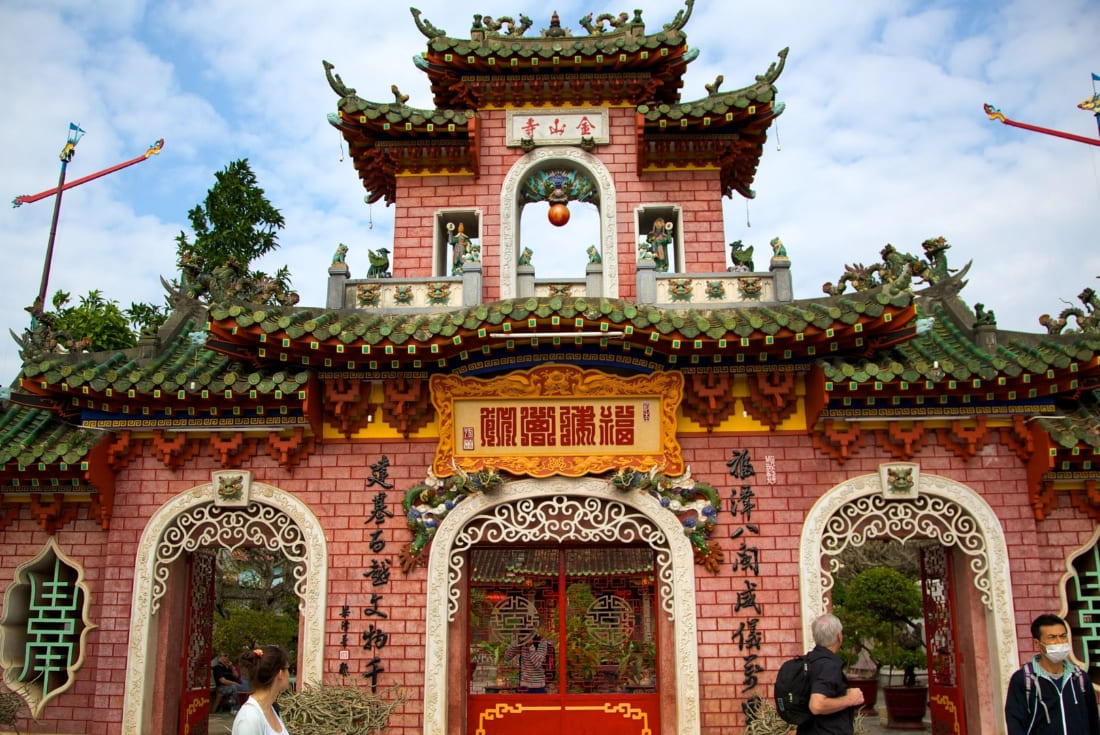
Ong Temple, formally known as Quan Cong Temple, was built in 1653 by the Chinese merchant community to honour General Quan Cong – a historical figure from the Three Kingdoms period who came to symbolise loyalty, integrity, and righteousness. The temple was restored six times between the 17th and 20th centuries, most recently in 1966. Its facade features tubed enamel tiles, sculpted mythical animals, and calligraphic panels above the entrance doors. The main hall houses a two-metre statue of Quan Cong flanked by his generals, Chau Xuong and Quan Binh. Annual ceremonies take place on the 16th day of the first lunar month and the 24th of the sixth.
2. Ba Mu Temple
- Address: 675 Hai Ba Trung Street, Minh An Ward, Hoi An
- Opening hours: Open daily, no strict regulated hours | Free entry
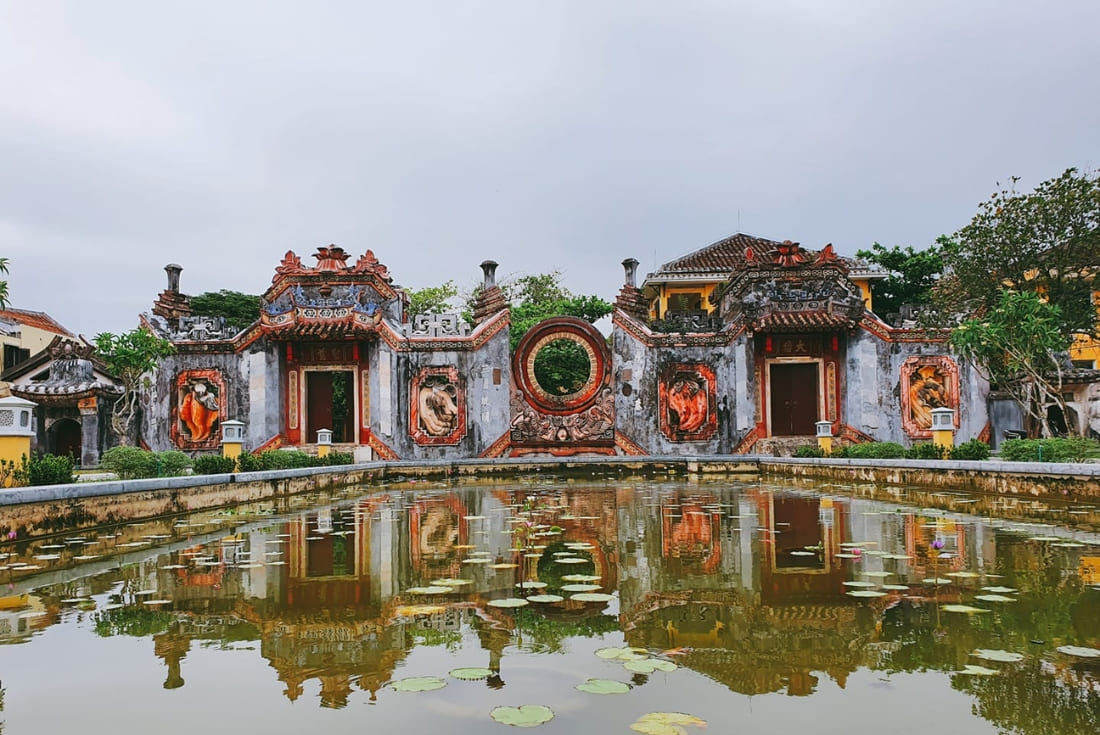
Ba Mu Temple holds an unusual place among Hoi An’s religious sites: only its three-gate entrance survives intact, the main structure having been largely lost to successive periods of damage and change. That entrance – built in a Vauban-style tiled architecture, painted in faded terracotta and ochre – remains one of the most photographed elements of the Ancient Town. The site is associated with Cam Ha Cung and Hai Binh Cung folk beliefs, and a small lake in front of the gate reflects the structure against the sky. Its architectural value lies precisely in what remains: an entrance that frames the spiritual threshold without the building behind it.
3. Phuoc Lam Pagoda
- Address: Le Hong Phong Street, Cam Ha Ward, Hoi An City, Quang Nam Province, Vietnam
- Opening hours: 7:30AM – 9:30PM daily | Free entry
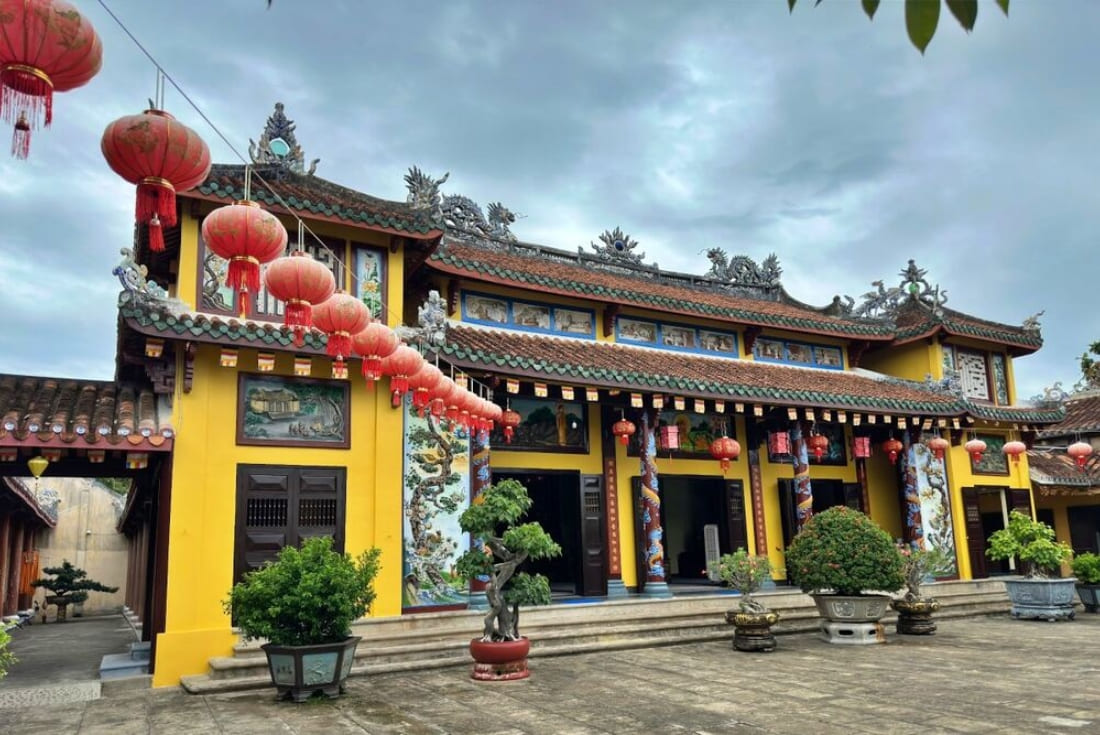
Phuoc Lam Pagoda was established in the mid-18th century by Zen Master Minh Giac and has been led by 14 generations of abbots. Under the Nguyen dynasty, it was granted the title Bien Vang Sac Tu – an imperial honour reserved for temples of particular merit. The pagoda’s layout follows the Chinese character for ‘country,’ with a main hall at the centre flanked by bell towers, east and west wings, and a rear ancestral shrine. The grounds preserve a collection of antique woodblocks, ancient porcelain bowls, and stupa tombs for past abbots. Visitors who arrive on foot from the Ancient Town typically pass through Chuc Thanh Pagoda first, approximately 350 metres before the Phuoc Lam entrance.
4. An Lac Pagoda
- Address: Nguyen Du Street, Thanh Ha Ward, Hoi An City, Quang Nam Province, Vietnam
- Opening hours: Open daily | Free entry
An Lac Pagoda was founded in 1966 and occupies a distinct position among Hoi An’s religious sites – it was built specifically to serve as a shelter and school for orphans during the war period. That founding purpose separated it from older ceremonial pagodas. Over subsequent decades, the structure was renovated and expanded, and today it functions as a working Buddhist temple. Its riverside setting on the right bank of the Thu Bon River gives it a quieter character than the sites within the Ancient Town itself, and visiting it requires a short ride out of the centre.
5. Van Duc Pagoda
- Address: De Vong River, Cam Ha commune, Hoi An, Quang Nam, Vietnam
- Opening hours: Open daily, daylight hours
Van Duc Pagoda is an ancient Buddhist temple in Dong Na hamlet, Cam Ha commune, Hoi An city, founded in the late 17th century by Zen master Minh Luong of the Lam Te Chuc Thanh school. Built on a 600 m² riverside site facing the De Vong River, it preserves traditional Vietnamese pagoda architecture with a “tien duong – hau dien” layout, dragon-decorated roofs, a solemn worship system, ancestral hall, and a stupa garden, making it both a serene spiritual retreat and a rich cultural stop for visitors.
6. Hai Tang Pagoda
- Address: Cham Islands, Hoi An City, Quang Nam Province, Vietnam
- Opening hours: 8AM – 5PM | Free entry
Hai Tang Pagoda sits at the base of a mountain on Cu Lao Cham Island, approximately 15 km offshore from Cua Dai Beach. Built in 1758 on a site selected for its feng shui alignment, the pagoda combines Buddhist and folk worship traditions within a three-gate entrance compound that houses century-old wooden statues and an Avalokitesvara Bodhisattva set in a lotus pond. What distinguishes Hai Tang from Hoi An’s other religious sites is structural: the pagoda operates without a resident abbot, without votive paper, without electric lights, and without monks – a set of conditions that produces an atmosphere of stillness difficult to find elsewhere in the region. Reaching Hai Tang requires a boat crossing to Cu Lao Cham, making it best combined with a Cham Island day trip from Hoi An.
7. Phuc Kien Assembly Hall (Fujian Assembly Hall)
- Address: 46 Tran Phu Street, Minh An Ward, Hoi An Ancient Town
- Opening hours: 7AM – 5PM
- Entrance fee: The entrance fee to the Fujian Assembly Hall in Hoi An is included in the general entrance fee to the Ancient Town. Specifically: 80,000 VND/Vietnamese visitors and 120,000 – 150,000 VND/international visitors.
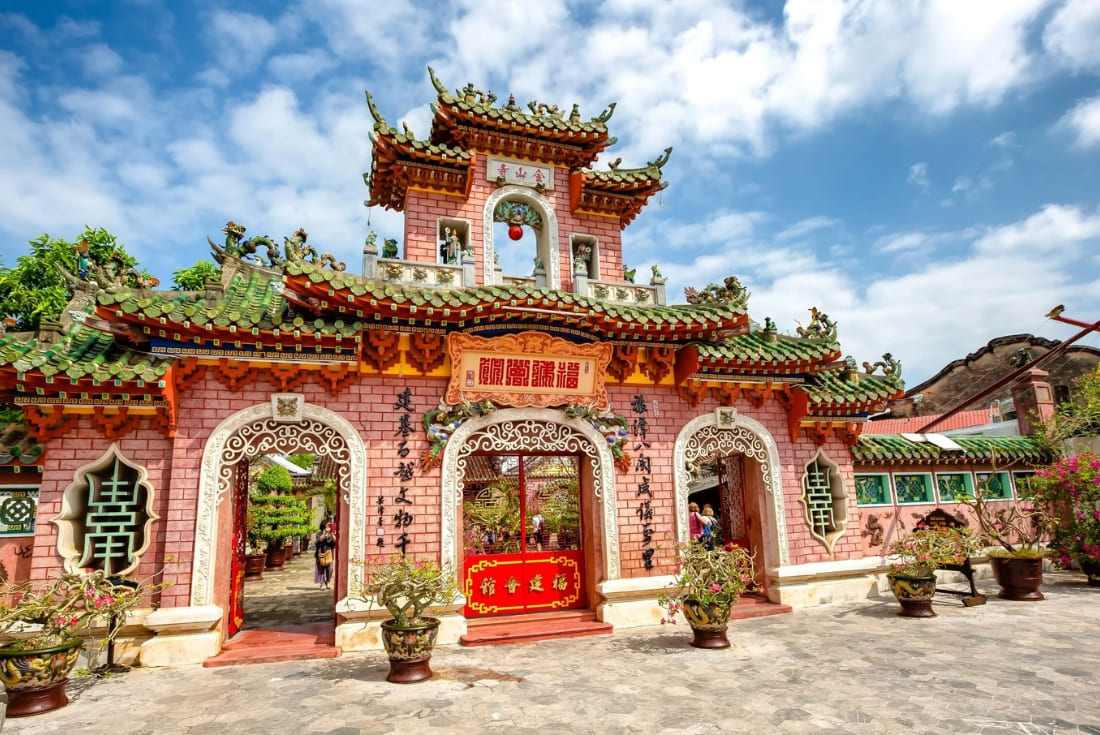
Phuc Kien Assembly Hall was established in 1697 by Fujian Chinese immigrants and dedicated to Thien Hau, the sea goddess who protected traders on their voyages. It is the largest of Hoi An’s five assembly halls and among the most visually elaborate. The main gateway features a Tam Quan triple entrance, curved yin-yang tiled roofs, and porcelain inlay work imported from China. The interior courtyard leads through successive ceremonial chambers to the central altar, where the gilded figure of Thien Hau is flanked by attendants. Two smaller halls on either side house altars for fertility and trade. The hall continues to serve as a cultural centre for Hoi An’s Fujian-origin community.
8. Japanese Bridge Pagoda (Cau Pagoda)
- Address: Nguyen Thi Minh Khai Street, Minh An Ward, Hoi An, Quang Nam 564010, Vietnam
- Opening hours: 9AM – 10PM
- Entrance fee: The entrance fee to the Fujian Assembly Hall in Hoi An is included in the general entrance fee to the Ancient Town. Specifically: 80,000 VND/Vietnamese visitors and 120,000 – 150,000 VND/international visitors.
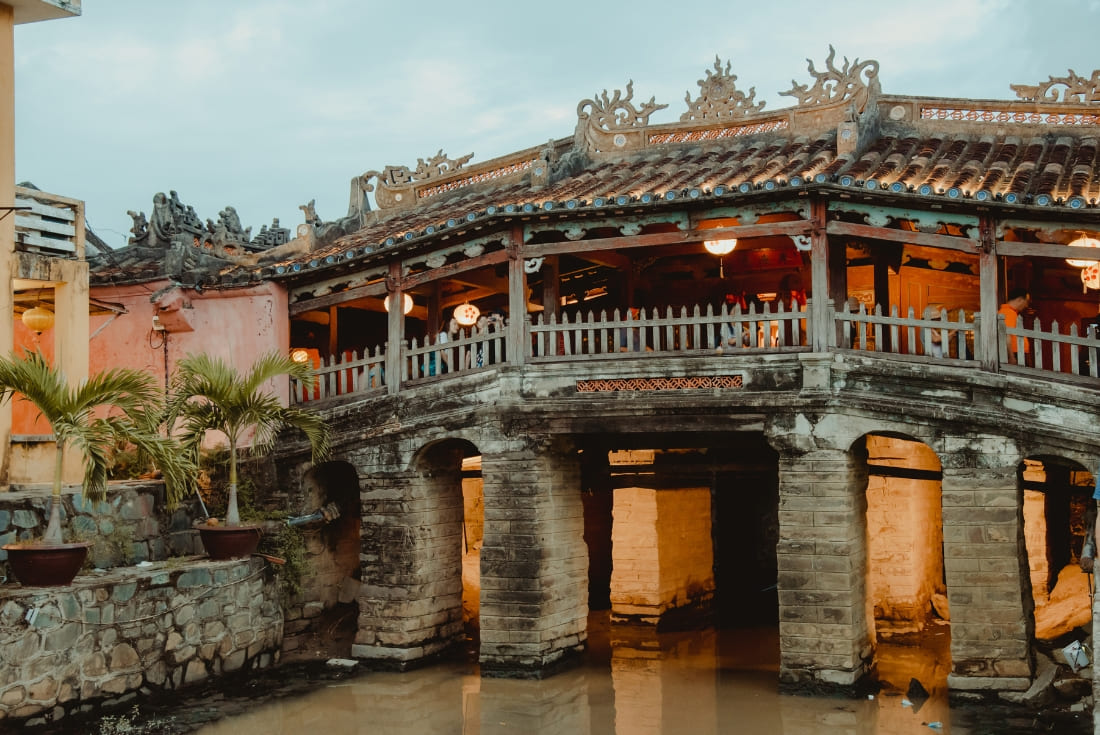
The Japanese Bridge Pagoda, or Cau Pagoda, is the iconic symbol of Hoi An Ancient Town, built in the 17th century by Japanese merchants over a small branch of the Thu Bon River and featuring a covered wooden bridge with a tiled roof, stone pillars, and elegant Japanese‑inspired architecture. What makes this place truly special is its deep cultural and spiritual meaning: it is tied to the legend of the Namazu sea monster and serves as both a historic trading link. The small temple atop the bridge is dedicated to Bac De Tran Vo, a Taoist deity associated with weather and water. and is honored as a national cultural relic whose image appears on Vietnam’s 20,000 VND banknote.
9. Quan Am Pagoda
- Address: 26 Tran Phu Street, Cam Chau Ward, Hoi An City, Quang Nam Province, Vietnam
- Opening hours: ~ 8AM – 6PM | Free entry
Quan Am Pagoda (also called Minh Huong Pagoda or Lady Buddha Temple) is one of the holiest Buddhist sites in Hoi An Ancient Town, located at 13 Nguyen Hue Street right within the UNESCO-listed old quarter. Built to worship the Goddess of Mercy (Guan Yin), it has a traditional three-arched gate, quiet courtyard and humble main hall where locals come daily to pray for good fortune, peace and a better life. What makes this pagoda especially unique is its rare position directly beside Hoi An Central Market, symbolically placing a serene spiritual space right next to the town’s busiest trading area and offering visitors a vivid glimpse of living local culture rather than just a historic monument.
10. Chuc Thanh Pagoda
- Address: Zone 7, Hoi An, Quang Nam, Vietnam
- Opening hours: Open daily | Free entry
Chuc Thanh Pagoda, founded in 1454, is the oldest Buddhist site in Hoi An. It was established by Zen Master Minh Hai, a Chinese monk who settled in the area during the town’s early commercial peak. The pagoda served as the founding location of the Thien Tam Te sect. Its architecture blends Vietnamese and Chinese elements, with lacquered pillars, carved animal motifs, and a prominent tower area housing 16 stupa tombs for eminent monks. The pagoda still preserves a 200-year-old stone gong and a wooden carp-shaped gong, both in active ritual use. An annual ceremony commemorating the anniversary of Zen Master Minh Hai draws Buddhist practitioners from across the province.
11. Kim Buu Pagoda
- Address: Trung Chau Village, Cam Kim Commune, Hoi An
- Opening hours: Open daily | Free entry
Kim Buu Pagoda was constructed in the mid-18th century by local villagers on Cam Kim Island, situated by the Thu Bon River approximately one kilometre from Hoi An’s centre. The structure is shaped after the Chinese character ‘Nhat’ (one), with three compartments and two sheds. Two bell towers inscribed with the character ‘Phuc’ (happiness) rise above the main structure. Kim Buu’s architecture is noted for its traditional woodwork, consistent with the craftsmanship tradition of the Kim Bong village nearby. In the 1940s, the pagoda served as a shelter and contact point for provincial resistance leaders. It can be reached either by the ferry that runs directly in front of the structure or by road from Hoi An.
Tips Before Visiting Temples and Pagodas in Hoi An
Hoi An’s religious sites remain active places of worship, not museum exhibits. The guidelines below reflect local custom rather than formal rules, but following them preserves the atmosphere that makes these places worth visiting.
- Dress Modestly: Clothing that covers shoulders and knees is the standard expectation across all religious sites in Vietnam. Lightweight cotton or linen works well in the heat. Several temples keep spare cloth wraps near the entrance for visitors who arrive without adequate coverage.
- Mind Your Volume: Many of these pagodas are in active daily use – monks and local worshippers may be present. Keeping conversations quiet and silencing mobile devices is not a request but a baseline courtesy.
- Respect Sacred Objects: Altars, statues, and offerings are not decorative elements – they are the functional centre of active worship. Touching them without invitation, or photographing the interior of a main hall without pausing to read the room, are both considered disrespectful. Many pagodas display no explicit signage but expect visitors to observe and follow the conduct of those around them.
- Prepare Cash: Most of the sites outside the Ancient Town ticket circuit accept voluntary donations. Carrying small denomination notes – 100,000 to 300,000 VND – makes contributing straightforward. For sites inside the Ancient Town, a single ticket (120,000 VND for international visitors as of 2026) covers entry to five selected sites, typically including Quan Cong Temple and the Japanese Bridge Pagoda.
Where to Stay to Explore Hoi An’s Heritage
Hoi An’s temples and pagodas are distributed across the Ancient Town and its surrounding wards. Having a base within easy reach of both the historic core and the quieter outer sites makes the difference between a rushed morning and a properly paced day.
Wafaifo Resort Hoi An is located 1.2 km from the Ancient Town via Ly Thuong Kiet Street. For guests interested in heritage and cultural programming, the resort’s Heritage & Culture Pathway traces the architectural and spiritual history of Hoi An through a series of curated installations built into the grounds. The lobby includes an exact replica of the Japanese Bridge – not an interpretation, but a full-scale reconstruction – integrated into the resort’s design as a reference point for the original structure in the Ancient Town.